
Client profile
Researchers, students and industry professionals requiring fast, accurate composition estimates to complement lab analytics.
Challenge & Solution
The ficoEst model estimates whole-body composition of farmed fish using a validated, science-based algorithm developed by SPAROS and published at Aquacultural Engineering. The model was transformed into a public web tool so that researchers, students and industry professionals can complement analytical methods and access advanced composition estimation capability..

Impact
A growing number of research groups and companies use ficoEst to complement analytical work. Its estimates have helped reduce the need for chemical analyses and have increased the amount of data obtained from in vivo trials. This has been particularly valuable at intermediate sampling points, where body composition was previously not measured due to budget limitations. As a result, trial data has become more comprehensive, enabling more detailed analyses, especially regarding nutrient retention.
The tool has been featured by FishFocus, The Fish Site and Aquahoy, reflecting its value to the broader aquaculture community.
Try yourself and let us know how you use it — we’re always interested in how it supports real‑world decision making.

Strategy
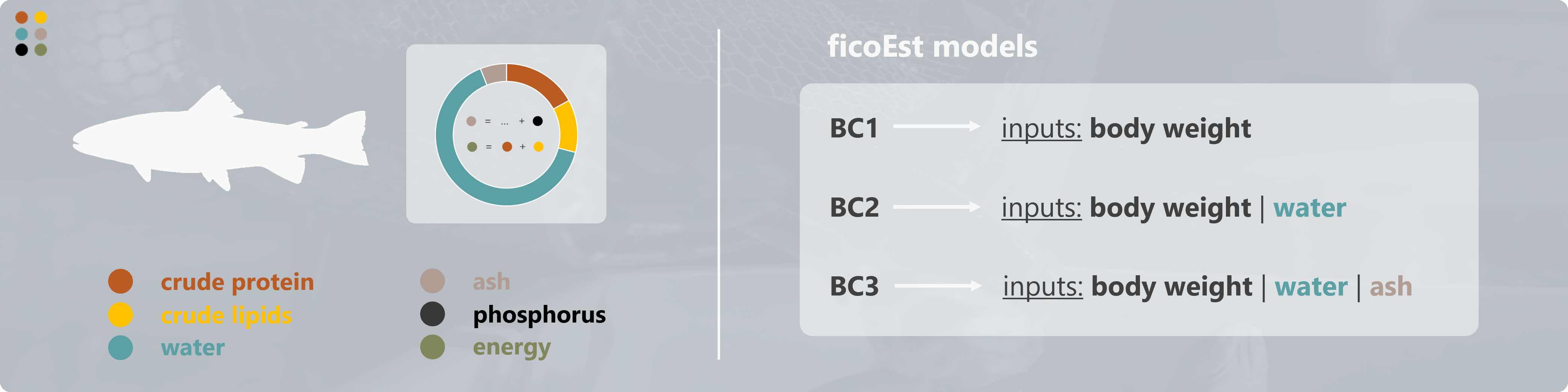
Its user-friendly interface allows the use of three different types of mathematical models to estimate the body composition of fish in terms of crude protein, crude lipids, water, ash, phosphorus, and energy. The models differ in the input data available to perform the estimates:
- Consider only body weight
- Consider both body weight and water
- Consider body weight, water, and ash as inputs
The model evaluation results demonstrate that considering water and ash as additional inputs to body weight significantly improves the accuracy in predicting some body composition components, such as crude lipids – up to 67.9 % more accurate, depending on the species considered.
ficoEst is currently available for six commercially relevant species: gilthead seabream (Sparus aurata), European seabass (Dicentrarchus labrax), meagre (Argyrosomus regius), rainbow trout (Onchorhynchus mykiss), Atlantic salmon (Salmo salar), and Nile tilapia (Oreochromis niloticus).
SPAROS can develop tailored models and tools built for other digital nutrition needs.
If this case study inspires you to explore your own species, data and objectives for a nutritional model or a web‑based application contact us.