
Client profile
Producers across the aquaculture value chain, from hatcheries and grow‑out farms to aquafeed, ingredient and additive suppliers, with well-structured datasets seeking to uncover hidden patterns and generate predictive insights that fully leverage the value of their data assets.
This service is also relevant for clients with a predictive aim who are at an early stage and require guidance on data collection protocols and data structuring to support future modelling efforts.
Challenge
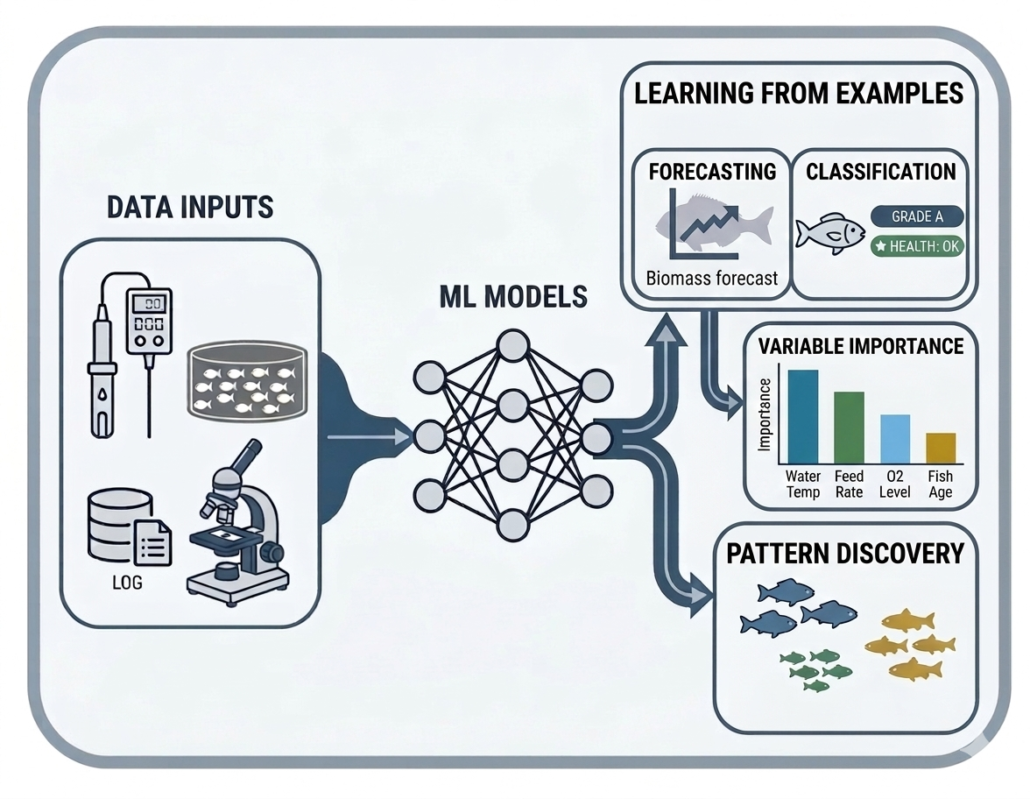
Aquaculture datasets often combine biological complexity with limited sample sizes, uneven class distributions, and heterogeneous measurements. These characteristics are common in nutritional R&D and health monitoring and strongly influence modelling feasibility, reliability and interpretability. In early stages, when datasets are still evolving, the key priority is to understand what the data can and cannot yet support. For structure datasets, machine learning can be applied to automate tasks such as classification, forecasting, and pattern detection.
Solution
SPAROS combines data exploration with applied machine learning techniques, ensuring that the client’s predictive ambitions are aligned with data reality. This approach avoids premature modelling, clarifies limitations early on, and establishes a clear roadmap for extracting value from both existing and future data.
Impact
Although predictive modelling services are still evolving within SPAROS’ Digital Nutrition portfolio, the potential impact of this approach is clear and tangible across several dimensions:
-
Improved data readiness
Clients gain a clear understanding of the strengths and limitations of their existing datasets, avoiding unrealistic expectations and misapplied modelling. Focused data collection insights from early-stage analysis directly inform data collection protocols, helping clients prioritise variables, sampling frequencies and data structures needed to enable future prediction.
-
Reduced uncertainty in decision-making
By identifying key drivers of performance and sources of variability, clients can make more informed operational and nutritional decisions, even before full predictive models are deployed.
-
Scalable predictive pathways
The workflow establishes a roadmap for progressively integrating machine learning as datasets mature, ensuring that future predictive tools are robust, interpretable and operationally relevant.
Practical experience
In a recent service delivered by SPAROS, machine learning techniques were applied to a client’s dataset with the objective of exploring predictive opportunities. While the initial expectation was to generate predictive status score outputs, early-stage analysis revealed important structural limitations in the data, including imbalanced classes, inconsistent measurement frequencies and insufficient sample sizes for certain status categories.
Rather than forcing a weak predictive model, the project focused on extracting maximum value through exploratory analysis, feature importance assessment, and the development of a preliminary predictive model. This enables the identification of distinct performance profiles across production units and highlighted the variables most strongly associated with key status scores. Equally important, the analysis clarified which questions the data could not yet answer reliably.
The outcome was a set of actionable insights for current operations, combined with concrete recommendations on how to adjust data collection and data structuring to support future predictive modelling. This service demonstrated that, particularly at early stages, the most valuable machine learning output is often not the prediction itself, but a clear, evidence-based path towards building predictive capability.
Strategy
In data-driven prediction services, SPAROS applies a structured workflow to determine whether a dataset contains meaningful predictive signal for robust modelling and, where needed, to clarify how current limitations can be addressed. Our workflow begins with exploratory data analysis (EDA), including the examination of variable distributions, assessment of category balance, identification of relationships between key variables, and the analysis of KPIs segmented by relevant grouping variables.
These steps provide the foundation for selecting modelling approaches that fit both the dataset and the client’s goals, helping to uncover hidden patterns and identify the factors with the greatest impact on KPIs. In practice, SPAROS can support applications such as:
-
Performance diagnostics for Growth, Feed Efficiency and Survival
Identifying genetic lines, groups of cages, sites, or production cycles with similar performance profiles, such as fast versus slow growers, optimal or inefficient feed conversion, or highlighting units with persistently higher mortality that require closer monitoring.
-
Quantifying the impact of controllable and environmental factors
Assessing how variables such as stocking density, feed composition, pellet size, fish treatments, water temperature, and oxygen fluctuations influence KPIs, using historical production data to provide a clear ranking of performance drivers.
-
Early disease risk detection
Analysing monitored health and mortality indicators to support timely management actions and limit the impact of outbreaks.
-
Early warning of hypoxic or other extreme events
Forecasting water conditions using sensor data, such as oxygen levels and temperature fluctuations, to support early preparation and risk mitigation.
Overall, these applications complement field-level expertise and the operational team’s accumulated knowledge, supporting more objective system management.
As datasets increase in depth, consistency, and temporal coverage, machine learning applications can be progressively expanded towards more advanced predictive use cases. Built on solid data foundations, these applications can significantly amplify the value of nutritional models, laboratory data, and operational records, particularly when combined with SPAROS’ modelling expertise.
If you would like to better understand the potential of your datasets, talk to us.
We can assess the meaningful information they contain and deliver actionable insights tailored to your production reality.